
How to Create a Sales Funnel for Affiliate Marketing
Driving traffic is only half the equation in affiliate marketing. The real challenge? Turning that traffic into paying customers.
That’s where the affiliate marketing sales funnel comes in.
It’s a structured journey designed to transform casual visitors into loyal buyers.
In this guide, we’ll walk you through each stage of the funnel, from building awareness to driving conversions, and show you how to create a system that works for your affiliate marketing strategy.
Whether you’re wondering how to build a sales funnel for affiliate marketing or looking to fine-tune your existing process, you’re in the right place.
Let’s dive in and break down exactly how to craft a funnel that drives results
Most affiliate marketers fail because doing it backwards.
They slap their affiliate links everywhere and wonder why nobody’s buying. They send cold traffic straight to someone else’s product page and hope for the best. Then they give up and say affiliate marketing doesn’t work.
But here’s what successful affiliates know – you can’t ask someone to marry you on the first date.
What is a Sales Funnel for Affiliate Marketing?
An affiliate marketing sales funnel is a structured process that guides potential customers from discovering your content to making a purchase through your affiliate link.
This funnel helps promote an affiliate product, even though the affiliate doesn’t own the product themselves.
For starters, the type of sales funnel we are discussing lives online so every touch point is on the internet versus traditional marketing funnels.
A sales funnel walks people from “Who are you?” to “Take my money!” in steps that actually make sense. It builds trust, provides value, and makes the sale feel natural instead of pushy.
The good news? You don’t need fancy software or a huge email list to get started.
In this guide, I’ll show you exactly how to build a simple affiliate marketing funnel that converts. We’ll cover every step from attracting the right people to getting them to click that buy button. No confusing tech stuff. No overwhelming strategies.
Just a clear path that turns strangers into buyers and puts affiliate commissions in your pocket.
How Is It Different From a Traditional Sales Funnel?
Ownership: In a traditional funnel, the product owner controls the entire customer journey. Affiliates, on the other hand, promote someone else’s product.
Sales Process: Traditional funnels might include internal sales teams, product demos, and direct customer interactions.
Affiliate marketing sales funnels rely on content, SEO, email nurturing, and persuasive calls-to-action (CTAs) to guide customers.
You may already have asked:
What is a sales funnel for affiliate marketing?
Understanding these differences will help you build better strategies.
Ultimately, an affiliate funnel bridges the gap between awareness and conversion, without ever owning the product.
Do You Really Need a Sales Funnel for Affiliate Marketing?
Absolutely. While some affiliates succeed with random traffic spikes or lucky one-off sales, a structured funnel boosts performance and consistency in your affiliate marketing efforts. Without a funnel, you’re likely to face:
-Low conversion rates due to a lack of nurturing.
-Scattered traffic that doesn’t engage beyond a single visit.
-Missed opportunities for upsells or retargeting.
So, do you need a sales funnel for affiliate marketing?
If your goal is sustainable revenue, the answer is a resounding yes.
In fact, the best sales funnel for affiliate marketing is one that nurtures leads at every stage and ensures they are consistently moving toward a conversion.
Creating a sales funnel for affiliate marketing means building a step-by-step path that guides potential buyers from discovering your content to purchasing through your affiliate link.
Instead of immediately asking people to buy something they’ve never heard of, you warm them up first. You attract them with helpful content, build trust by solvingľtheir problems, and then recommend products that genuinely help them.
Think of it like this: You meet someone (attract traffic), become friends (provide value), earn their trust (build authority), and then make a recommendation they actually want to follow (affiliate sale).
The funnel is just the roadmap that moves people through these stages naturally.
Why You Need to Know What a Sales Funnel is and How it Works
Let’s discuss the importance of knowing what a sales funnel for affiliate marketing is and the inner workings of its magic abilities and what it can do for the success of your business. The unlimited ways a sales funnel for affiliate marketing can boost your overall ROI is the number one reason I am going to teach you why you need to learn these skills or at least familiarize yourself with what a sales funnel actually is. Below I have highlighted reasons why anyone delving into digital marketing should understand what a sales funnel is and how it can help you boost affiliate marketing sales and overall return-on-investment.
Generates passive income streams – A well-built funnel works for you 24/7, making sales while you sleep or focus on other parts of your business
Builds trust before asking for the sale – People buy from businesses they trust, and funnels let you prove your expertise before pushing products
Increases conversion rates dramatically – Warm leads convert 5-10x better than cold traffic sent straight to a sales page
Reduces wasted ad spend – You’re nurturing people who showed interest instead of paying over and over to reach cold audiences
Creates multiple touchpoints with potential customers – Most people need to see something 7+ times before buying, and funnels make this happen automatically
Lets you monetize your audience without creating products – You can make money recommending other people’s solutions while you build your own
Teaches you customer psychology – Understanding how people move from stranger to buyer applies to selling anything, including your own products
Segments your audience by interest – You learn what your people actually want based on what they click and buy
Provides data on what’s working – Funnels show you exactly where people drop off so you can fix the weak spots
Scales your reach beyond your time – One funnel can reach thousands while you’re only one person with limited hours
Tests offers before creating them yourself – See what your audience buys as affiliates before investing time and money building similar products
Builds your email list while generating revenue – You’re collecting contacts and making money at the same time instead of choosing one or the other
My method for setting up a digital marketing sales funnel for affiliate marketing is simple for beginners. These are the steps and they look like this.
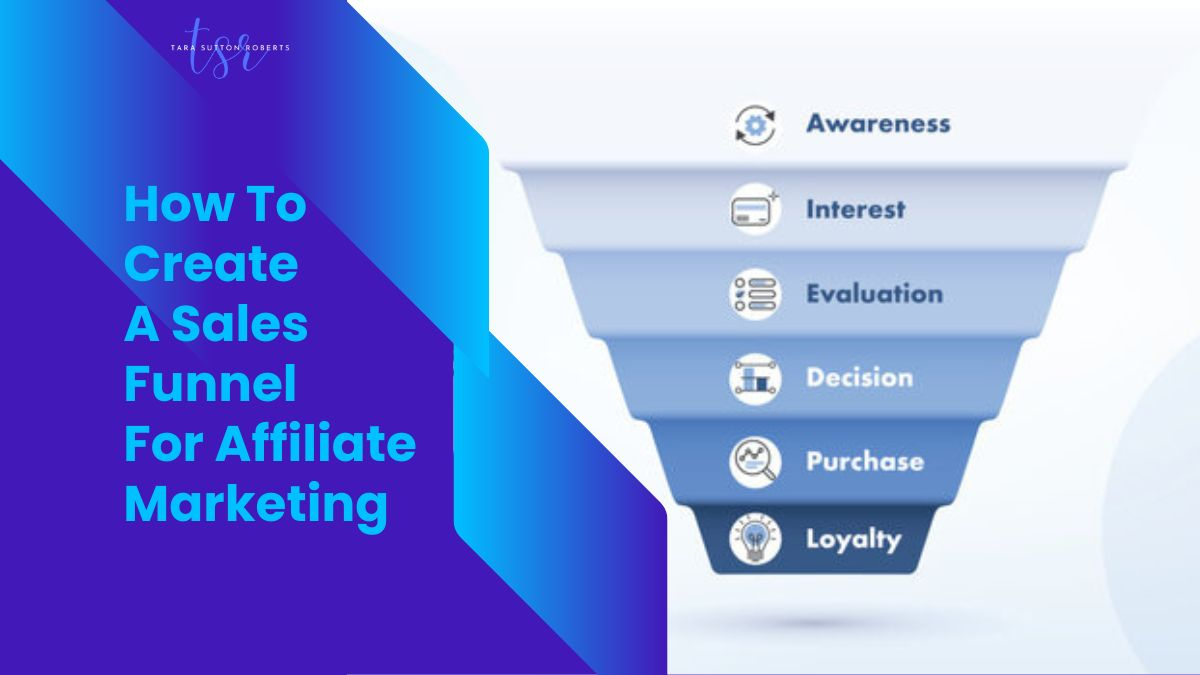
The stages of a funnel a customer goes through are First, AWARENESS. Then comes the CONSIDERATION phase, and lastly the DECISION stage which results in a purchased product.
When you put this framework model in your mind, it is easier to see which media formats go into which phase. For example, the awareness phase can include media options such as banner ads. So are you ready to get started? Let’s walk through building your funnel.
Step-by-Step Instructions to Create a Sales Funnel for Affiliate Marketing
The way I personally set up a sales funnel for affiliate marketing is making sure I hit all the stages from the beginning. I actually get a large piece of paper, turn it into landscape format and map out the funnel by drawing it out. I draw a box for the Attract phase, then I draw boxes for the following two phases – Engage and Convert., I will then add an illustration and description inside each box how I plan to execute each step. It is easier to understand how the entire process works once you map it out visually through hand-to-paper illustrations. This form of brainstorming, as elementary as it may seem, actually is a key step that most affiliate marketers include in their set up process.
Once you begin the brainstorming process, the entire sales funnel system starts to make a lot more sense in general. Now that you are equipped with this insight….you are ready to walk through the set-up steps.
Here are step-by-step instructions to create a sales funnel for affiliate marketing:
Step-by-Step Instructions to Create a Sales Funnel for Affiliate Marketing
Step 1: Choose Your Niche and Affiliate Product
Pick a specific topic you know well or are passionate about learning.
Then find an affiliate product that actually solves a problem in that niche.
What to do:
- Research affiliate programs on platforms like ClickBank, ShareASale, or Amazon Associates
- Look for products with at least a 30% commission rate
- Check reviews to make sure it’s actually good (don’t promote garbage)
- Make sure the product solves a real problem your audience has
Step 2: Identify Your Target Audience’s Pain Points
Figure out what keeps your ideal customer up at night.
What to do:
- Join Facebook groups where your target audience hangs out
- Read Amazon reviews of similar products to see what people complain about
- Look at Reddit threads and forums in your niche
- Write down the top 3-5 problems your audience is struggling with
Step 3: Create a Lead Magnet
Give away something valuable for free in exchange for an email address.
This is what gets people into your funnel.
What to do:
- Create a simple PDF guide, checklist, or template that solves one specific problem
- Make it something they can use immediately (quick wins build trust)
- Design it in Canva or keep it simple in Google Docs
- Name it something specific like “The 5-Day Meal Prep Blueprint” not “Free Guide”
Step 4: Build a Landing Page
Create a simple page where people can download your lead magnet.
What to do:
- Use tools like ConvertKit, Mailchimp, or Systeme.io (many have free plans)
- Write a headline that speaks to their main pain point
- Explain what they’ll get in 3-5 bullet points
- Add an email signup form
- Keep it simple – no navigation menu or distracting links
Step 5: Set Up Your Email Sequence
Write a series of emails that build trust and lead to your affiliate offer.
What to do:
- Email 1: Deliver the lead magnet and introduce yourself
- Email 2-3: Share helpful tips related to their problem (no selling yet)
- Email 4: Tell a story about how you or someone else struggled with this problem
- Email 5: Introduce your affiliate product as the solution
- Email 6-7: Handle objections and share more benefits
- Email 8: Create urgency with a bonus or limited-time angle
Space these emails 1-2 days apart.
Step 6: Create Content That Drives Traffic
You need to get people to your landing page.
What to do:
- Write blog posts targeting search terms your audience uses
- Create YouTube videos answering common questions in your niche
- Post valuable content on social media with a link to your lead magnet
- Join relevant Facebook groups and help people (don’t spam your link)
- Consider running small paid ads to test what converts
Step 7: Add Value Content Between Promotional Emails
Don’t just pitch your affiliate product over and over.
What to do:
- Send regular emails with tips, stories, and helpful content
- Use the 80/20 rule: 80% value, 20% promotion
- Share personal experiences and lessons learned
- Ask questions and encourage replies to build relationships
Step 8: Track Your Numbers
Know what’s working and what’s not.
What to do:
- Check your landing page conversion rate (aim for 30-50%)
- Monitor email open rates (20-30% is decent)
- Track click-through rates on your affiliate links (2-5% is good)
- Calculate how many sales you’re getting per 100 email subscribers
- Use Google Analytics or your email platform’s built-in tracking
Step 9: Optimize What’s Not Working
Look at your numbers and fix the weak spots.
What to do:
- If people aren’t signing up: Test a new headline or lead magnet
- If emails aren’t getting opened: Improve your subject lines
- If people aren’t clicking your links: Make your call-to-action clearer
- If clicks don’t convert to sales: You might be targeting the wrong audience or promoting the wrong product
Step 10: Scale What’s Working
Once you’ve got a funnel that converts, pour more traffic into it.
What to do:
- Create more content targeting similar keywords
- Invest in paid ads now that you know your numbers
- Build similar funnels for related affiliate products
- Partner with other content creators in your niche
- Repurpose your content across multiple platforms
Step 1 – Understand Your Target Audience and Product Start by defining your ideal customer profile (ICP) and understanding your target niche.
What are their pain points? What solutions are they actively searching for? Choose affiliate offers that align with their needs.
Step 2 – Set Up a Landing Page or Lead Capture
A dedicated landing page helps you capture leads and present the affiliate offer clearly.
Use opt-ins, forms, and embedded affiliate links for seamless conversions. Ensure your landing page includes an effective opt-in form to capture leads.
Step 3 – Use Email Sequences to Nurture Leads
Craft email drip campaigns that combine education with gentle promotion. Share insights, case studies, and include affiliate links naturally throughout the sequence to provide valuable information that builds trust and engagement.
Step 4 – Optimize with Analytics and A/B Testing
Monitor key metrics like click-through rates (CTR), conversion rates, and bounce rates to ensure you have an effective sales funnel. Use Google Analytics, Hotjar, and affiliate tracking platforms like Reditus (perfect for B2B SaaS) to refine your funnel.
Quick Start Checklist
- Choose your niche and find a quality affiliate product
- Research your audience’s biggest problems
- Create a simple but valuable lead magnet
- Build a landing page with email signup
- Write 7-8 emails for your welcome sequence
- Set up your email automation
- Create your first piece of traffic-driving content
- Monitor your conversion rates
- Optimize based on data
- Scale your successful funnel
Remember: Your first funnel won’t be perfect, and that’s okay. The key is to get it live, test it with real people, and improve it based on what actually happens. Most successful affiliate marketers went through dozens of tweaks before finding their winning formula.
Start simple, stay consistent, and let the data guide your decisions.
Key Considerations For Successfully Creating a Sales Funnel for Affiliate Marketing
Make sure you remember the 1, 2, 3 process that goes into the overall arching funnel set up
Remembering the core framework: Attract, Engage, Convert.
Every piece of your funnel should serve one of these three stages. Your content attracts people who have a problem. Your lead magnet and email sequence engage them by building trust and providing value. Your affiliate recommendations convert them by offering the solution at the right moment.
The biggest mistake? Rushing people through these stages. You can’t skip from attract to convert and expect it to work. Someone who just discovered you today isn’t ready to buy a $500 product tomorrow. They need time to know you, trust you, and believe you actually care about solving their problem.
Also, your funnel is never “done.” The best affiliate marketers treat their funnels like living systems. They test different lead magnets, rewrite email sequences, try new traffic sources, and track everything. What works today might stop working in six months. Stay curious, keep testing, and let your audience tell you what they want through their actions, not just their words.
H3: Taking it to the Next Level: How to go beyond the sales affiliate marketing funnel
Beyond creating a successful set up of your sales funnel for affiliate marketing, there are a couple of options of pivoting to the next step.
You’ve built your affiliate funnel. It’s converting. Money’s coming in. Now what?
Most affiliate marketers stop here. They keep doing the same thing, promoting the same products, hoping the income keeps flowing. But there’s a ceiling to that strategy, and you’re about to hit it.
The truth is, your funnel was just the beginning. It proved you can attract an audience and get them to buy. But if you want to build something that lasts, something that grows beyond trading time for commissions, you need to think bigger.
The next level isn’t about optimizing your email sequence one more time. It’s about leveraging what you’ve already built to create multiple income streams, build real authority, and maybe even launch your own products.
This is where most affiliate marketers get stuck. They know there’s more potential, but they don’t know what to do next.
In this guide, I’ll show you exactly how to take your successful affiliate funnel and transform it into a real business. We’re talking about strategies that turn you from “someone who promotes stuff” into an authority people trust and follow.
Ready to stop leaving money on the table? Let’s go beyond the funnel.
H3: Alternatives to Creating a Sales Affiliate Marketing Funnel
The traditional funnel isn’t the only way to sell affiliate products.
Some marketers prefer the holistic approach, where every piece of content naturally weaves in product recommendations without a structured sequence. You’re not guiding people through stages—you’re creating an ecosystem where solutions appear exactly when people need them.
Others swear by the Flywheel approach, which focuses on delighting customers so much they become promoters. Instead of pushing people through a funnel that ends at purchase, you create momentum that keeps spinning. Happy customers refer others, creating a self-sustaining cycle that grows over time.
There’s also SPIN selling (Situation, Problem, Implication, Need-Payoff), which works especially well for high-ticket affiliate products. You ask questions that help people discover their own need for the solution, making the recommendation feel like a natural conclusion rather than a sales pitch.
Finally, the Inbound methodology aligns your content with the buyer’s journey (Awareness, Consideration, Decision). You create different content for each stage and let people consume what they need, when they need it. This works great if you have lots of content and want people to choose their own path.
The funnel approach gives you control and predictability. These alternatives give you flexibility and often feel more natural. Choose based on your audience, your content style, and how hands-on you want to be with the process.
Alternative options to the sales affiliate funnel marketing approach include: the holistic approach, Flywheel approach, SPIN selling, and the Inbound methodology (the buyer’s journey).
H2: Wrapping Up and My Experience With Creating a Sales Funnel of Affiliate Marketing
I’ve always been hesitant before ever setting up a sales funnel due to the complexity in the number of steps and I know you can relate if you’ve landed here on this article. After this guide, you will be able to follow the set up steps to accurately set up a funnel that has customers converting like never before. You will have the correct framework and be able to implement this effective marketing strategy to create a successful campaign.
Building a sales funnel for affiliate marketing isn’t rocket science, but it does require strategy.
You now have the complete roadmap. Attract people with content they actually care about. Engage them with value that builds trust. Convert them with products that genuinely solve their problems. Follow these steps, track your numbers, and adjust what’s not working.
The difference between affiliate marketers who make pocket change and those who build real income? They treat it like a business, not a side hustle they hope works out. They test, optimize, and stay consistent even when results don’t come overnight.
I’ve spent years figuring out what actually works in digital marketing—not just theory from a textbook, but real strategies tested with real budgets and real results. I’ve made the expensive mistakes so you don’t have to. I’ve watched campaigns fail spectacularly and others succeed beyond expectations. And I’ve learned that success in affiliate marketing comes down to understanding people, providing genuine value, and being patient enough to let the process work.
Your funnel won’t be perfect on day one. That’s fine. Launch it, learn from it, and make it better. The only way to fail is to never start.
Now stop reading and go build something.

Hi I’m Tara! I’m a digital marketer who specializes in turning marketing budgets into measurable revenue. With over 15 years of experience managing campaigns for national, regional, and local clientele as well as “soloprenuers” for everything from the beverages industry to the banking industry, I’ve learned what actually drives conversions—and what’s just expensive noise. When not analyzing CAC ratios or optimizing funnels, you’ll find me breaking down the latest marketing tactics on my blog to help business owners stop guessing and start growing.